



In The Most Important Communication Tool is Intent, there was an example of NVC where the person says “I felt abandoned”. Whoops. This is a big faux pas in NVC, so some nice NVC-fans chimed in to helpfully say that isn’t how NVC works. “Abandoned” is not a feeling, my friend! It is a statement of what we believe the other person did. If you are communicating nonviolently, why would you make such an offensive claim? Presumptive! Violent!
In NVC-world, “abandoned” is a great example of what they call a “pseudo-feeling”. Or, a thought disguised as a feeling.
I used to be a big fan of NVC. Actually I still am! It did me a lot of good! Enough good that *I* used to be the one who would write a comment about this exact thing! I’d even go one further and ask a friend or lover in the middle of a delicate conversation: “You are saying you feel abandoned, but that isn’t a feeling... Can you explain more clearly what you felt?” And I’d whip out the handy dandy NVC list of feelings:
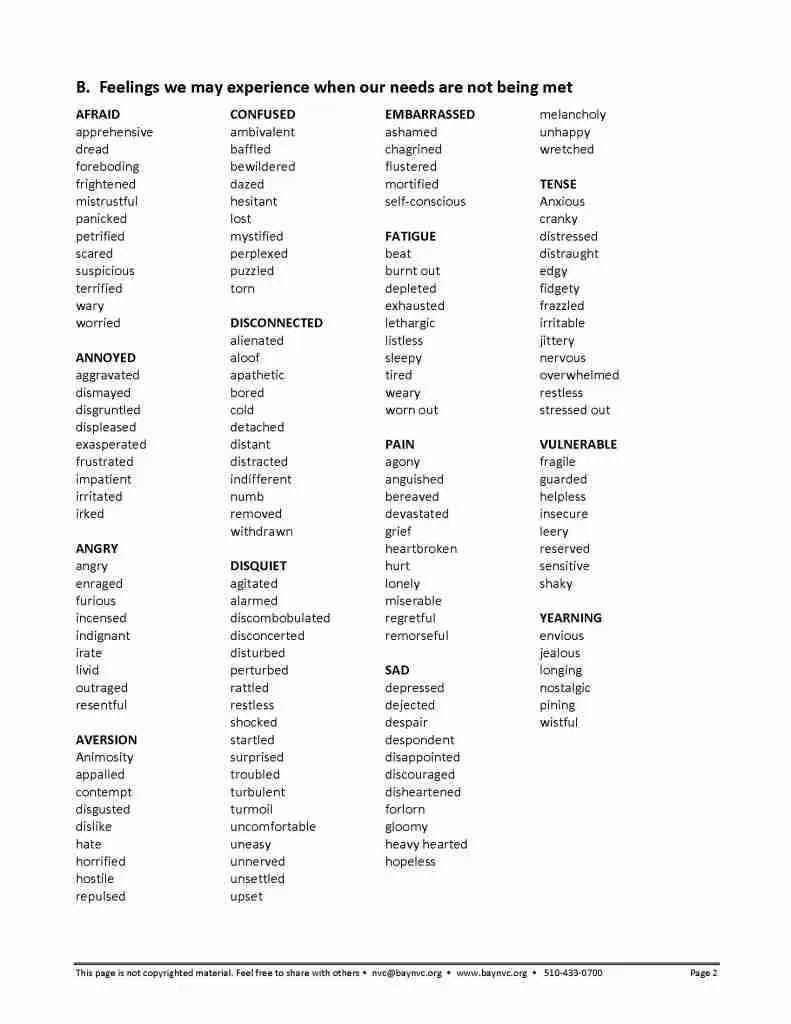
I still like this sheet. It’s great for helping someone grow an emotional vocabulary. But I do cringe to think I rejected a loved one’s reports and tried to put their feelings in a box of ~160 words. Now that I’ve moved beyond it, I can say why NVC is wrong about “pseudo-feelings”.
The NVC Stance
NVC is a 4-step process:
1. State observation (When you cancelled our plans)
2. State feeling (I felt abando—I mean.. lonely!)
3. State human need (because I have a need for your lov—I mean…love in general!)
4. Make request (can you please be better about respecting our plans)
Non-violent communication is trying to help two people create common information so they can move forward from a shared truth. I’m not sure this is how it would explain itself, but that’s the effect it is going for. The idea is that “I felt abandoned” is making a claim about what the other person did. Such a statement is said to be your thought, interpretation, evaluation, or judgment disguised as a feeling. Then your conversation partner is likely to disagree and want to argue the point in response. Even if they don’t want to argue, it is sneaky and hard to address. It gets in the way of that common information/shared truth goal. It leaves less space for your partner to explain themselves without endorsing that they did a bad behavior.
I understand this. Yes, that is all true, if the sentence is “You abandoned me.” But it is not!
The Uniqueness of Feelings Vs. the Vocabulary of Emotions
The truth is that NVC is talking about emotions, not feelings in general. Feelings are in the body. They are as varied as the postures, pleasures, and tensions your body can perform.
“Emotions” are big, recurring, pieces of feelings we have given a name to. Emotional language is not perfect, but we as a society have decided to do the best we can by giving these pieces words of their own, since we know they come up again and again. But the feelings are actually more varied and particular than one emotion. They are very collaged and conflicting. And the feelings are what are actually happening in physical reality! They are, in that sense, tracking reality more closely than emotional vocabulary does.
Perceptions of what someone else has done leads to the body producing a unique feeling. Feelings are in the body, and they are attempting to tell us what happened in the world. They do arise because of our unconscious beliefs, values, and ways we have been primed, yes, but the result is feelings. And feelings arise because of what happened across time. The body has a memory and is tracking what’s occurred for your safety. You can’t just say “sad” or even “lonely,” “hurt,” “afraid,” or even all four, because it doesn’t capture the change in state which occured and the particular nuance. Your body is telling you “there has been a change.” A feeling is a unique response that comes with a particular shape of pain or pleasure. It can not be separated (philosophically) from the stimulus, one will beget the other, so why artificially try to?
Sentence structure is a way to instantly create near-infinite feelings
Since these feelings are unique according to each perception, there is no reason to choose a different vocabulary word for it. The clearest and fastest way to convey the precise unique feeling is to reuse the perception itself which generated it. Saying “I felt abandoned” is actually shorthand for “I felt as I would have felt had you abandoned me, and those feelings are something we don’t have another word for, so I’m referencing that so you can remember in your body what I mean“. So yes “felt abandoned” is a feeling. That’s the structure we innately decided works for describing [that particular feeling which arises if you are abandoned].
Okay, if works so well, why don’t you try it?
Okay. I will try on “I felt abandoned.” Hm. I can say that “abandoned” feels like being alone and bereft, plus my skin is kind of reaching out in hollow tingles (sensing the air), but something has been swept off of me, something I had, and warmth was taken with it. And my spirit that was high has crashed down low. And my soul that was blooming is now in stasis and considering a new direction to bloom in. Bodily it feels like a blanket was ripped off of me in winter. And now I must make myself small and hide, my body and subconscious compels me to do that. Now my body has to constrict or shimmy away to protect it’s remaining warmth. Maybe it is primed to run off in the opposite direction where it is warm and where the blankets act predictably. I am timidly tensed away from the relationship.
This is not very efficient for conversation. “I felt abandoned” is better.
If you can’t inhabit this, then that is why that isn’t working for you. You need to be in your body, and then you won’t call these pseudo-feelings. They will be information-rich shapes of consciousness you can try on.
You could take it one step further: Figurative Language
In fact, you can go beyond that, and speak poetically. If abandonment feels different to different people and in different moments (and it will, based on the personalities and what has come before), one can move further in specificity and abstraction, by speakng poetically.
Remember how I said the blanket stuff above? Would you be able to understand your partner better if they said something like that? “I felt like a blanket got ripped off of me, and now I’m out in the cold with no protection” Why not try it out? And I think we can agree that the blanket analogy is different from feeling like you were put in the trash, or had a rug pulled out from under you. These are very information dense ways of discussing feelings.
“But, you can’t feel like these things happened if they didn’t happen to you” My friend, you can feel like you are blessed by the gods. You can feel like your loved one has infinite value. You can feel like someone has thrown you a parade. If you do enough psychedelics, you can even feel like you are a pizza in the oven.1 Your conversation partner can definitely feel like a human being who has had a rug pulled out from under them and fallen on their ass, without any drugs at all.
All this gives good information, MORE than the NVC-style feelings
As I said earlier: “These feelings do arise because of our unconscious beliefs, values, and ways we have been primed.” This is GREAT though. I want all these values and beliefs on the table in their most raw, psyche-laden form. This is how we’re really gonna get somewhere! If you really have the intent to understand your partner and create a shared truth, “I felt abandoned” is a goldmine!
A good conversation partner will hear “I felt abandoned” and view it as useful information to meet someone where they are. “Oh, so in some sense you thought I abandoned you? You feel bereft and alone, etc? Did I abandon you? How similar was it to abandonment? Why did I do something like that? How are you primed to ascribe ‘abandonment?’ Is there something about me that is causing the patternmatching? Why does hearing this surprise me, why do we see it differently? Why does hearing this not surprise me, why do we agree? And how can we help each other? I swept away your blanket and now you are shrinking in the cold, you say? Maybe we can work on giving you so many ‘blankets’ in life, that when you perceive that one ‘blanket’ is whipped away, you don’t feel cold, instead you just smile because it seems like the other person needed the ‘blanket’ more themselves right then?”
What’s more, you can see where someone is in the process of endorsing vs releasing their perception by what verb tense they use:
“I felt abandoned” implies “at the time, I percieved some sort of abandonment flavor, although I don’t endorse or feel that anymore to the extent I did then”
“I feel abandoned” implies “I’m still considering whether or not you abandoned me. But, hey, at least I’m talking to you. I can’t be too attached the story, let alone to an idea that this makes you bad or something.”
That brings me to my final point. If you try on the feeling for yourself, this also tells you that your partner has just done a Big Thing by even telling you “I felt abandoned”. Even bigger if they say “I feel abandoned.” When you try on the feeling in your own body, you’ll know how hard that must have been for them to say, for you know how much one is compelled to stay small or slink away when one feels abandoned. You can appreciate how far they travelled to commune with you, and how vulnerably. Meet them there.
Don’t fix what ain’t broken, you (nonviolently) crazy cats.
An experience I have had. I was employed at a pizza shop at the time.
YES. i had this realization doing a bio-emotive workshop and it was huge for me ("abused" and "betrayed" were particularly huge for me at the time). the way doug tataryn explained it was something like "feelings are our emotional brain's best understanding of what's happening relationally" or something like that and it unlocked a whole huge thing for me. the NVC pseudo-feeling thing is close to a form of distributed gaslighting tbh
I completely agree with this. I also feel that NVC's attempt to police feelings vs. pseudo-feelings is an example of missing the point: if wholesome intent is established, saying "I feel abandoned" will be heard just fine.