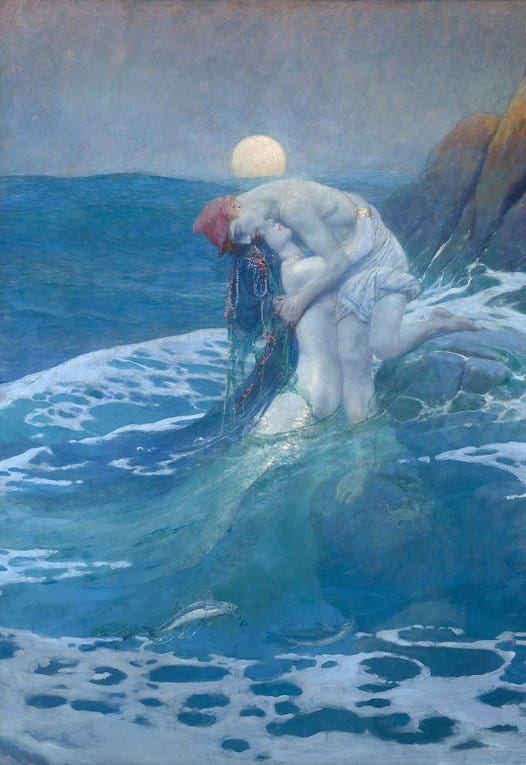
This short story shows where penetrating life with metaphysical abandon can get you!
This piece does some“telling,” not just “showing.” I want to help people struggling in love to “get” love and romance, and that’s gotta include people who need things spelled out. I kinda like this style though, personally!
Part 1
A. Your train is cancelled. The app says forty minutes. You sigh, text your buddy that you’ll be late, and stand on the platform scrolling through things you won’t remember. Light is doing something on the tracks, but you don’t look up. When the train finally comes you’re irritated and behind, and at the bar you start off by saying the trains are terrible.
Or
B. Your train is cancelled. Hm. This is the part of the movie where the hero misses his train. You head to the street smiling in sweet surrender, and look for a “sign” (from heaven?) of what to do—something that strikes you.
You see the brownstones have turned the color of honey in the evening sun, so you stop and look. You consider the concept of golden hour, and riches streaming down from heaven. Where are the riches? West-ward? You want to keep this light, but in ten minutes it’ll be gone. The wanting is sweet in itself. And you believe this is a rare day—not every day affords this. So you follow the sun West. You don’t consider whether a person can catch the sun by walking West, you just go.
You take a block you’ve never walked, until the street dead-ends at the river. There’s a little pier there you never knew about, nearly empty: a few benches and one guy fishing. You note that he is seeking riches just like you, tossing his humble bait into the depths. You walk out to the end of the pier.
The sun is going down behind the Manhattan skyline, and the whole river has turned gold. You bid goodnight to Apollo and welcome the falling night. You taste the bittersweetness of a completed journey. Then you start another one—you head back to the train station.
At the bar you don’t mention the pier you found. You’re saving it for someone.
Part 2
A. It’s your first date. She’s telling you about growing up by the ocean, and you’re nodding while you consider what to say back: something interesting, but not too much. She says she misses the water. You almost tell her about a spot you like by the river, then decide it’s too forward, so you say, “Yeah, the city’s a lot,” and ask about her work. At the subway you can’t tell if she wants a kiss, so you go for a hug. She texts “had fun!” and then nothing.
Or
B. It’s your first date. She’s telling you about growing up by the ocean, and you hear a musical lilt when she says she misses the water. It’s the most beautiful thing she’s said tonight. You think of the pier you found last week—the one you’ve been saving. It’s the perfect storied setup. Though you can’t know if she’ll want to see it, you ask for the check. “There’s somewhere I want to show you, if you’re up for a cold walk.”
“What kind of somewhere?”
“You’ll see, but I promise you’ll like it,” you say. You carry a charge of liberated desire in your eyes and body. But there is also the steadiness of having—because you know you have a gift to give her. You look at her and let yourself have faith that you’ll get a beautiful reaction (that’s the way the story goes). Just for the pleasure of looking forward to it, you imagine being at the pier with her. Your demeanor softens. She can sense it.
“If you say so.” She smiles and finishes her drink.
It’s cold, but you give her your scarf so she can be the warmer of the two of you. She tries to refuse but you insist, saying that you want to see her in it (true). “Oh, is that sooo?” she says, and wraps it around her neck. She looks at you and raises an eyebrow. “What a beautiful picture that is,” you say. She smiles, but sort of leans into you, bumps her shoulder against you, and bounces off. You sense this was her way of half-accepting the compliment (and your attention!) and half-brushing it off. You take the silly flirt’s hand.
When you reach the pier, she looks at you with curiosity.
“You said you missed the water.”
She smiles. “You were right. I do like it.” She looks at you with new eyes. From the intensity of her stare, you know she’s intrigued about you and isn’t trying to hide it.
The pier juts out across the vast dark of the water. As you walk to the end, you get acquainted with the place again. Last time the river was golden. This time it is the black of night. You feel a bit exposed, and you realize that there are no buildings, trees, or walls to break the tension, provide protection, or interrupt your far-seeking gaze. You reach the end of the pier and you both relax, a bit wistful, a bit vulnerable.
You sense a strangeness come over you in this setting. You remember how water has been a symbol of mystery throughout history. You consider the paradox it contains: stillness and motion, lethal yet vital. You want to keep holding the paradox because it feels somehow exquisite. You say “Let’s take our time here.”
“Yeah.” She leans against the railing and watches the water. Over the river hangs the Manhattan skyline—a noble replica of the stars which completely outshines them. You are struck by the setting’s narrative gravity—it pulls you in. It is not cliche to you, but a chance to make myth real, and fulfill prophecy. To live out a universal theme is to be connected with all of humanity by a golden thread. It especially connects you to her because she is in this culturally-loaded moment with you. You can both guess what’s in the other’s imagination. You know she is carrying the same story.
What a gift it is to have had your preconceptions built up by the artistis and lovers of history. For you, moments like this are imbued with bubbling power. Yes, that’s it. You are not anxious, you decide. You are just reckoning with the power of the moment.
You both are still looking out at the river. You allow yourself to feel drawn and imagine possibilities. You sense how magical it would be to put your arms around her. “And warmer too…” you smirk at the thought. So you move a couple inches closer over, and then shape your body beside and against her, and then put your arm around her, and then place your other hand atop her hands, protecting them from the snap of the wind. Each act led naturally to the next because you took those actions from your own center and your own desire. As each action landed, you allowed yourself to feel the pleasure of stepping into your role. Now you allow yourself to rest in your strength and feel warmer in this new configuration—tangled up together.
She understands of course. Her body is cold too, and she has also been imagining. She presses close as well, and leans her ear against your shoulder. But she looks down at the water. Maybe she is a bit shy. Maybe deep in thought or fantasy. Maybe a bit sad. You give her that grace, to remain as she is now, and don’t take it personally. You don’t have to add her quiescence to your story, unless it is beautiful and yours. And she hasn’t given it to you. Your own story is already solid, carefully crafted through life, by adding and following what strikes you.
She’s not giving signals, so you just keep following your own inclinations. Without thinking about it, you squeeze her hand. This shows her you care and that you are still holding her in your mind. But really you did it because your body knows that a little action like that often gives the last moment a fitting close. It makes it feel like the right time to turn your mind to a new page.
You look at the water again. You consider it, and her. Both beautiful, both striking. You allow yourself to be struck and tantalized by their power. The power of water. An image flashes—a tsunami: massive, rushing, white waters wash away a village. What does it mean to let something wash over you? You try letting her wash over you. It feels good.
You let your peripheral vision take her in while you watch the water. You think of how she grew up near the water. “So she is of the water,” you think. But so are you. You’ve made a life on this island’s edge in New York. A split second thought—are the two of you more like two islands, two fish, or two boats?
You look at her—steady, but with the wind in her hair.
“Two boats,” you think, “with the wind in our sails.”
She moves to look up at you… completing your reverie. You pull back so you can look at her too. You both smile sweetly. Now you sense a rising energy in your chest and arms. You yearn to kiss her. You want to get even closer—to know and feel what it’s like to kiss her. To feel her wash over you.
…Or maybe you are meant to crash into each other like two waves. As soon as this thought arises (simultaneously perhaps, you can’t be sure), you are struck by the truth of it, encouraged, and compelled.
You step forward and grab the arms of her coat to hold her steady. You kiss each other, and it feels right. It feels thrilling and calming at the same time. You keep kissing. Heat rises in your body and she presses upward into you.
You pull apart, and she looks into your eyes.
You look back, feeling curious, amazed, and happy in your heart. You notice that her eyes are sparkling like the water reflecting the city lights. Her home is the water. You’ve taken her home. Does she sense that? What does this moment mean to her? You can’t really know, and you won’t ask for now. Maybe one day you will tell your children this story and you’ll ask her. For now, you consider how else you’d like to take her home.
A scene darts through your mind, and you see how you’d grab her body and move against her. How you’d mix fire with water and see who wins.
Probably her.
The white sheets in your vision remind you of sails.
“Would you like to come home with me?”
A bigger smile.
”Yes.”