


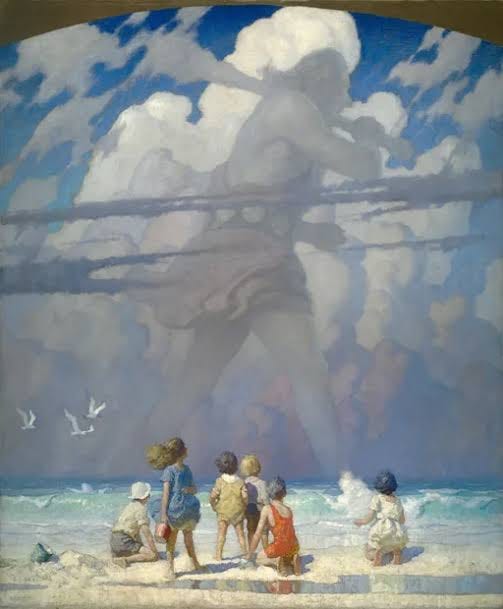
How do you follow where such a thing bids you?1
My vision for this blog has been to teach about romantic love and its fullest possibilities—specifically to compile all I have learned in the last year of researching, reading about, living, and testing love. My larger mission is to usher in a new age of true love. This means turning people who struggle to feel, find, and keep love into people who can do all that easily.
The only thing is that propagating one of the greatest mysteries of being over text is a truly challenging endeavor. If you already know, you know. If you don’t, what then?
In person, in coaching and workshops, it is easier. You can move into your body. You can bring love into the room. You can laser through to them with your heart and they see the sparkle in your eye and are sweetened... then their armor melts like sugar in the rain. The gears of their imagination creak forward and possibilities entice. Their body glows with pleasure and takes on the directionality of longing and attachment. All true ideas bottom out in the real world, and love is accessible to all, so you can show someone in the real world how it goes.
Over writing, it is trickier.
Oh, how many things I have to tell! So many things I want to crow about and never stop for breath! I even believe I am precise enough to be as understood as any wise person could hope to be in telling things. But would only a fool hope for any understanding from that?
Today I read Siddhartha for the first time. It came at the right time, for I was speaking with a friend about wanting to “kill off” my overintellectualization and desire to control. Really, I framed it as my “blue magical energy.” It’s not the right energy for this mission which is about wisdom, feeling, passion, and love. But it is the energy I’ve held for so much of my life, and it is the default tone I take on when I’m trying especially hard to say true things. So how to “kill off” this fundamental part of me? My “blue mana” has felt like a cross I bear for some time, yet progress has been slow.
My friend offered that I need an injection of a different way of knowing—intuition and the following of the natural way. (Green magical energy, specifically). Perhaps Siddhartha would do.
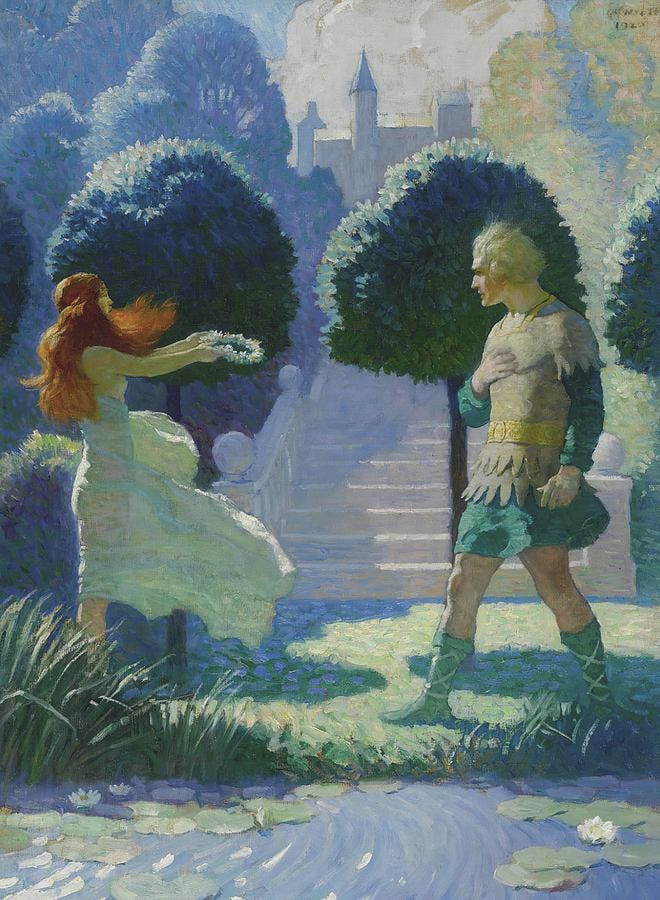
A friend offered me a gift, so I accepted it.2
The book was extremely fitting and beautiful, while also being of very little comfort at first. For it said what I already believed (I do have a lot of green mana). It emphasized the warning which already haunted me about this whole project:
“Wisdom cannot be passed on. Wisdom which a wise man tries to pass on to someone always sounds like foolishness.”
And in case someone still believes in the power of transmittance:
“Too much knowledge had held him back, too many holy verses, too many sacrificial rules, to much self-castigation, so much doing and striving for that goal! Full of arrogance, he had been, always the smartest, always working the most, always one step ahead of all others, always the knowing and spiritual one, always the priest or wise one. Into being a priest, into this arrogance, into this spirituality, his self had retreated... Now he saw… that no teacher would ever have been able to bring about his salvation.”
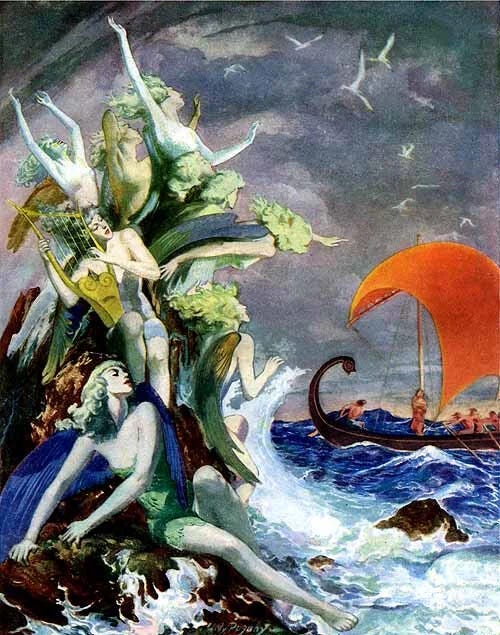
The siren song of facts and direction alone3
Can any teacher bring about someone’s salvation by trying to state the simple facts of what one knows or feels in the moment? I have never seen it done. I have seen an education transmitted this way, but never a transformation, let alone salvation. Informing is not transforming. Why? Because statements of fact are not sufficient to generate a state of mind, to change a person. The lesson of Siddartha is that one has to live in order to learn. How can you force your reader to live?
Well, the answer comes from going one step up in abstraction. Siddartha itself, the book, is transformative to read. I’ve been transformed by romantic tales. I am transformed by art and movies. These are not transmitting pure fact. They are Story. They are sensory. By putting someone through a story or parable, you give them a sort of living, and by using figurative language, you let them sense the real world. The resulting paradox is that you can often say things which are much more precise to the reader by diverting from the pure fact. Adding fantasy makes the lesson more true than explaining plainly.
Unfortunately for me and my audience, I’m still becoming proficient in this. I’ve known for a while that narrative creativity is a pillar of being a true romantic, of getting your own head and heart moving in the romantic direction and keeping them in love. But it’s not a reflex for me yet. I am still learning to channel narrative with a bigger message, to notice how things overlay and what common truths are repeated in different forms, in order to create a tapestry of meaning. Not heavyhanded or trite, but just flowing and true.
This morning, my vision for this blog had been a how-to guide on finding true love. Now I’m thinking more like a Love Compendium. Crosslinking all the things you’d need to know about love and how to find true love. I’ll still shine a light on topics like:
-What causes you to fall in love with one person vs someone else
-Can passionate love last
-How to fall in love and keep falling in love
-How to become scintillating
-How to create romantic moments and titillating moments
But now I know I must mix it up within each piece much more. And it isn’t negotiable or optional. Facts can open the doors of perception. But still someone has to walk through them by living. So if words will work in full, if they are to prompt a transformation between the start of the page and the end of the page, it will be because they thrust the person into life.
Transcribing a recipe of how to reveal a great mystery is not sufficient to ensure the great mystery will be revealed. If it were, all of Buddha’s students would be enlightened. People have to live the mystery themselves from their own center. When you are following a recipe, you are not shaping yourself freely anymore and living. You are following someone else’s prescription, and the goal and method hangs in your mind, blocking the subconscious and conscious from meeting.
Even writing my own (current) passions and pleasures is not enough. The readers who actually need the transformation will mostly squint at a soaring heart in the distance. How to transport them to that faraway place? Force the living of it. Imbue life, which is a journey. Tell a story… maybe even my story!
So over the next month, I’ll be practicing the art of narrative: story, parables, allegory, and figurative language wherever possible.
I want my writing to do the same for a love-lost reader as a real-life session or workshop. That would be amazing and so impactful. My lesson from Siddhartha is that, if a post doesn’t thrust the person into life, physicality, and the senses, it isn’t ready to go out. It has to pass the reader through the doors of perception. I already knew this in some sense, but was unwilling to admit just how deep the rabbit hole goes… just how much information can and should be replaced with narrative. This will be a lot of work and much more vulnerable, but also a pleasure.
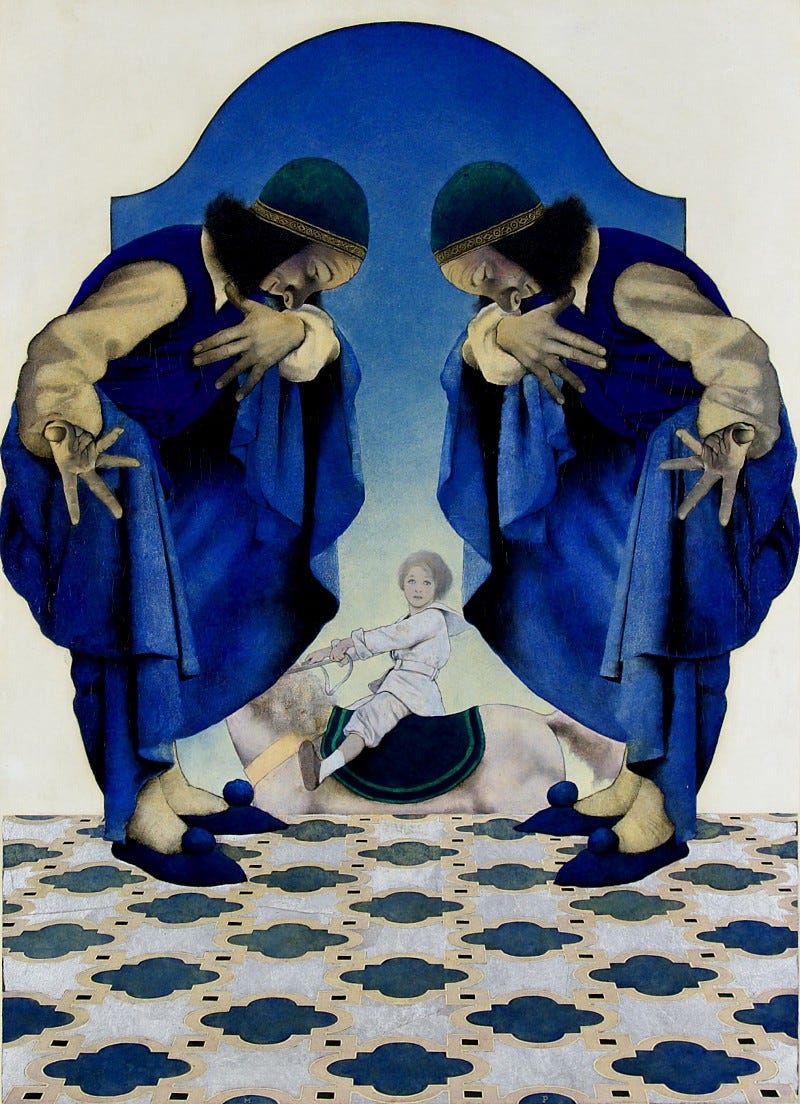
Oh little thinker, ever riding the horse of fact!
You and your thoughts are very welcome here.
But you must come down from your steed to enter the mystery,
The realm of imagination, desire, and love.
Come and think different types of thoughts.4
“No, there was no teaching a truly searching person, someone who truly wanted to find, could accept. But he who had found, he could approve of any teachings, every path, every goal, there was nothing standing between him and all the other thousand any more who lived in that what is eternal, who breathed what is divine.”
My mission is to help the searching, love-lost types, those who are too stuck in their heads and scarcity mindset to feel and keep love, to become “those who have found.” Naturally, to help them, I must allow my own heady intellectualism to be subsumed into a different power of thought, the power of imagination, dreams, and fantasy. And I must release my own perfectionism and desire to control so I can risk practicing something new—the art of narrative.
I started the day by wanting to kill off my blue magic. What I have experienced instead is a transformation. My blue magic of thought is now a different type. Not the blue of lofty academic towers, but the blue of the ocean and sky.
And now for a cool Tarot Addendum:
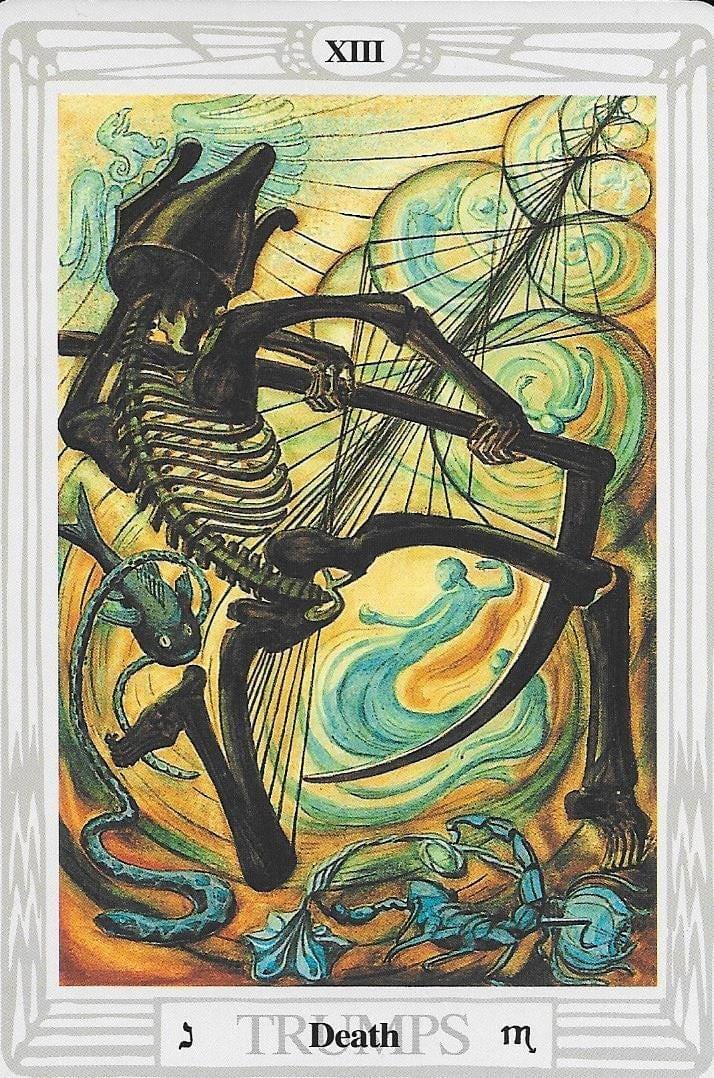
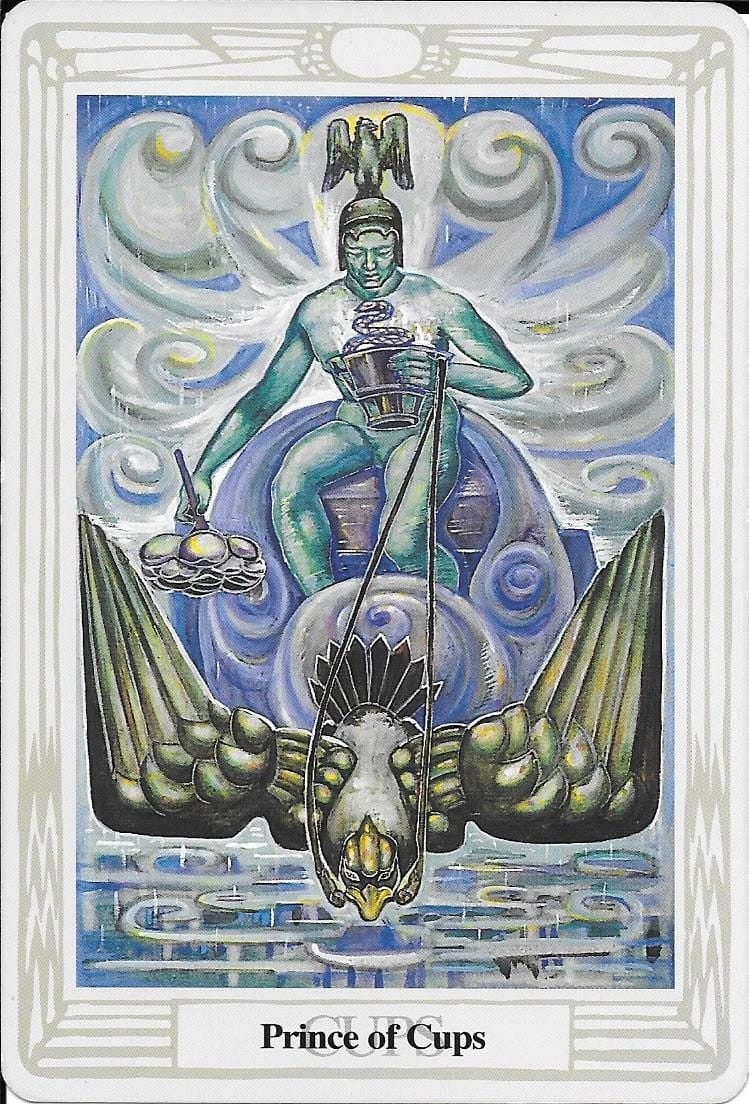
This morning, I had asked the Thoth deck what mood I should embody to write the introduction to my “How to Find True Love Sequence”, and this is the card I drew.5 The Death card is about transformation. Something dies and something else grows in its place.
Believe it or not, I had a very simple explanation for drawing Death—that I should scrap the idea of writing a sequence, and instead write a flexible encyclopaedia of many short, crosslinking posts. (Oh, how rigid I was that I really considered that a transformation worthy of drawing Death!)
And then I moved right along, and spent the whole day very intentionally trying to “kill off” my blue magic. Because I knew in my soul that no matter the project’s form, my blue shadow did not fit any project about love. Despite literally saying “kill off” many times, I did not make the connection to the Death card until sitting down to write. And I did not see the blue magic of the ocean and sky (blue sea creatures and bird are on the card!) until after I’d spent the day delving into fantasy myself.6 Once again, the truth is revealed in the living of the story!
“The Giant” by N. C. Wyeth, 1923
“Ogier and Morgana” by N. C. Wyeth, 1924
“The Temptations of Ulysses: Sirens” by Willy Pogany, 1948
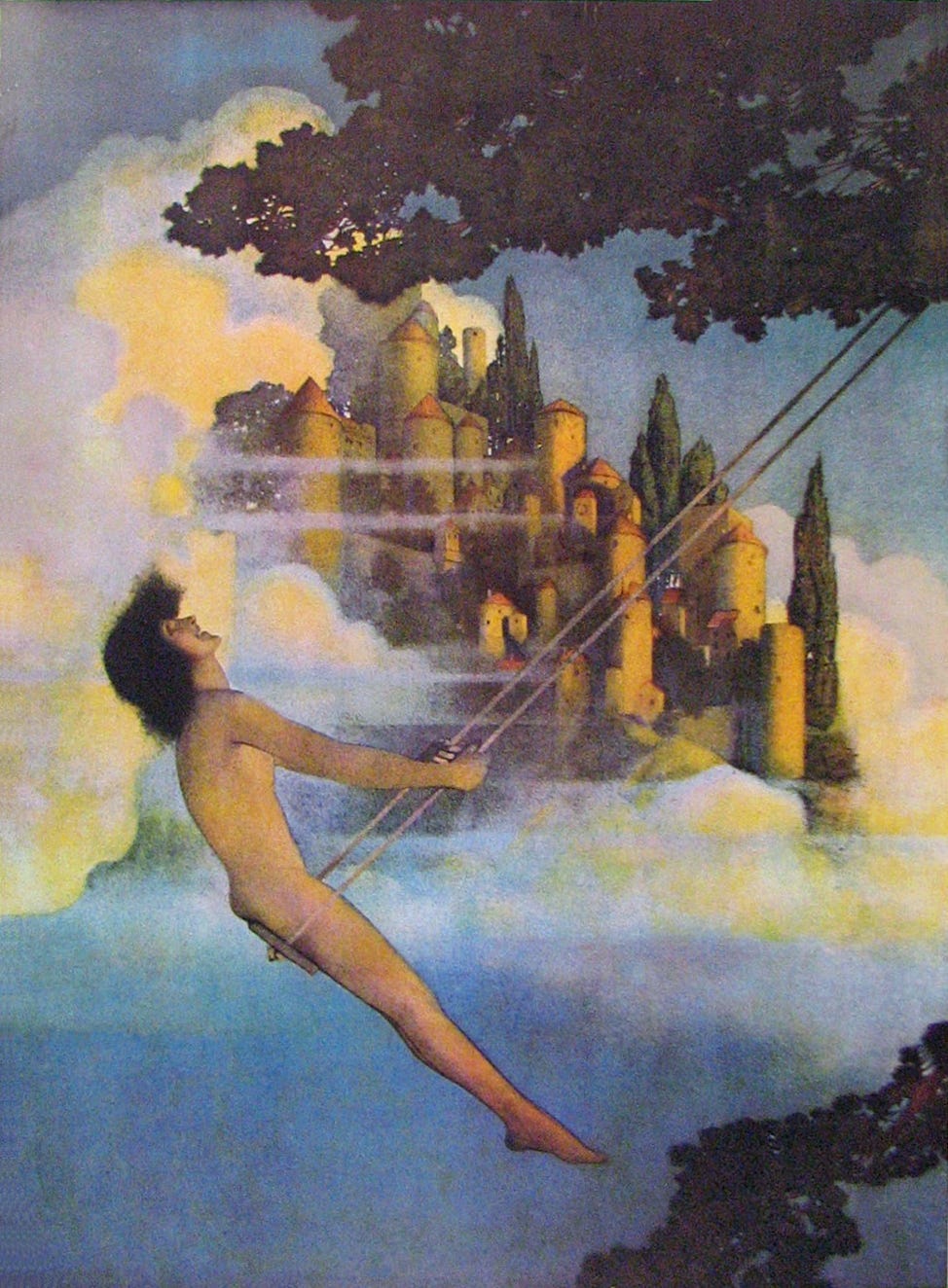
“The Fly-Away Horse” from Illustration for Poems of Childhood, by Maxfield Parrish, 1904
“Death” from the Aleister Crowley Thoth Tarot Deck, by Lady Freida Harris, ~1943
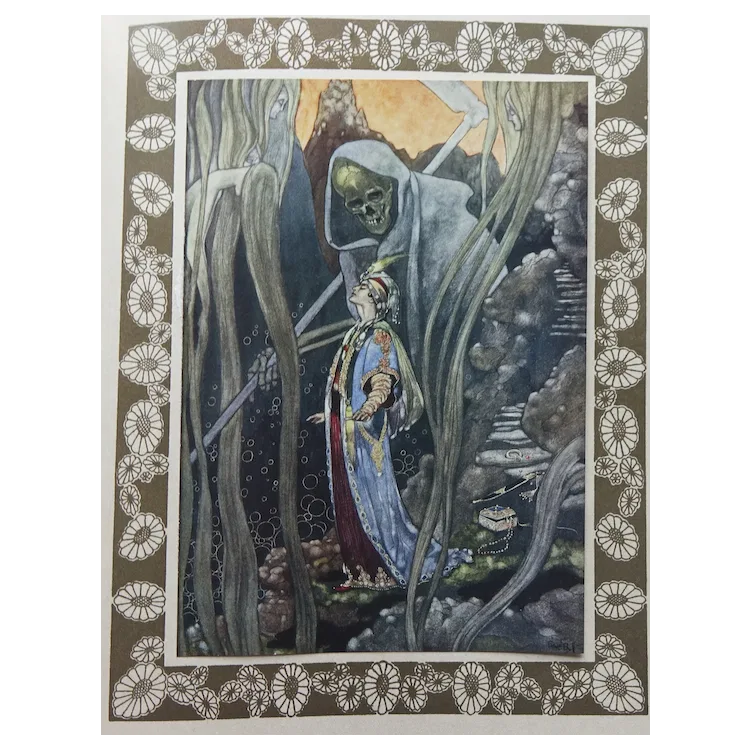
From “The Rubaiyat of Omar Khayyam” as illustrated by Edmund Dulac, 1909